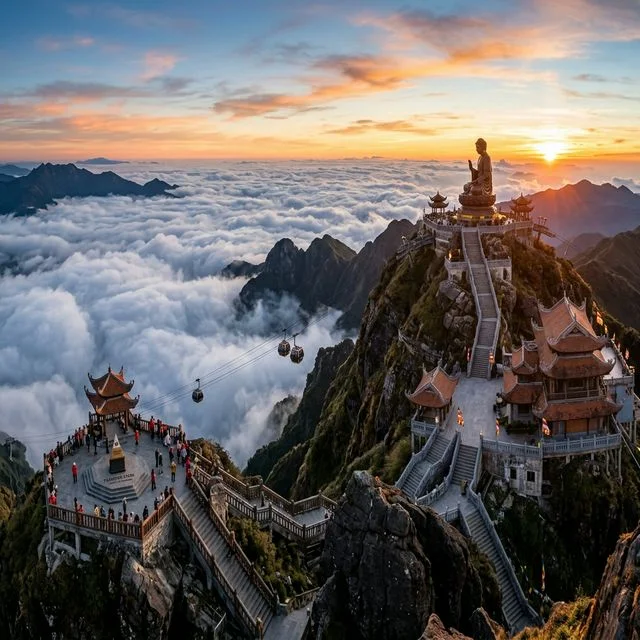
At 3,143 metres above sea level, Fansipan is the highest peak in Indochina. Reaching its summit on foot — rather than by cable car — is an experience in its own right: two to three days in ancient rainforest, a night in a high-altitude refuge, and landscapes that very few travellers ever get to see. There are three routes to the top, each with its own logic, challenge and rewards.
Why hike Fansipan on foot rather than take the cable car?
Hiking Fansipan on foot offers total immersion in old-growth forest, H'Mông villages and high-altitude landscapes that the cable car cabins never reveal.
The cable car is fast, spectacular and ideal for families or visitors with limited time. But it only shows one side of Fansipan. Trekking takes you through rhododendrons in spring bloom, misty bamboo groves at mid-altitude, and lichen-covered zones above 2,800 metres. It means hours of walking through pristine forest within Hoàng Liên Son National Park — one of Vietnam's most biodiverse protected areas.
For travellers who come looking for the true face of northern Vietnam, trekking remains the defining experience. We have accompanied hundreds of hikers on these trails since 2005, and the satisfaction at the summit is always the same, whichever route you choose.
What is the Tram Ton route, and why is it the most popular?
The Tram Ton route is the shortest of the three: around 11 km from the Tram Ton pass, with a night at a refuge at 2,800 m and approximately 1,200 metres of elevation gain.
The hike starts from the Tram Ton pass, 15 kilometres from Sapa town centre at an elevation of 1,900 metres. It is by far the most frequently used itinerary: more direct, better marked and suited to hikers in good physical condition without specific high-altitude experience.
The first day climbs steadily through giant fern forests and rhododendron groves to the camp at 2,800 metres. The second day is short but intense: a final push to the summit stele at 3,143 metres, then the descent by the same trail. Expect 6 to 8 hours of walking on day one and 4 to 5 hours on day two.
This is our recommendation for travellers embarking on their first major trek in Vietnam. The Tram Ton route combines accessibility, beautiful scenery and a genuine sense of achievement, without requiring mountaineering experience.
What is the Sin Chai route, and who is it suited for?
The Sin Chai route crosses isolated H'Mông villages over approximately 14 km; less frequented and more rugged than Tram Ton, it suits experienced trekkers seeking authenticity.
This itinerary starts near Sin Chai village, west of Sapa. It follows trails that see far fewer visitors, passes through largely undisturbed forest, and often brings you face to face with Black H'Mông communities living well off the usual tourist circuit. These encounters, in their everyday setting, are often what our clients remember most vividly.
The Sin Chai route is frequently combined with the Tram Ton route as a loop: ascending via Sin Chai, descending via Tram Ton — or the reverse — with one night at the high camp. This loop format allows you to experience two very different forest atmospheres in a single trek. Allow 2 to 3 days depending on your pace.
The difficulty is real: trails are less clear, navigation more demanding, and local guides are even more essential here than on other routes. This trail is not recommended outside organised circuits.
The Cat Cat route: who is it truly designed for?
The Cat Cat route is the longest and most demanding of the three itineraries: around 19 km from the H'Mông village, with two nights at altitude and landscapes of exceptional wildness.
This route starts from the well-known Cat Cat village, 3 kilometres from Sapa town centre. It unfolds over 3 days and is the least-travelled of the three. The intermediate camp sits in Qua Thao Forest at around 2,150 metres altitude, before a second stage to the 2,800-metre camp and the final summit push on the third morning.
The Cat Cat route is reserved for experienced trekkers who are in excellent physical condition and have prior mountain hiking experience. The terrain is demanding, often slippery after rain, and the long stages require sustained endurance. The reward is proportional: extraordinary biodiversity, near-total solitude on the trail, and a summit truly earned.
How do the 3 Fansipan trekking routes compare?
| Route | Distance | Duration | Difficulty | Best for |
|---|---|---|---|---|
| Tram Ton | ~11 km | 2 days | Moderate | Hikers in good shape, first high-altitude trek |
| Sin Chai | ~14 km | 2 to 3 days | Difficult | Experienced trekkers, travellers seeking authenticity |
| Cat Cat | ~19 km | 3 days | Very difficult | Seasoned trekkers, high endurance required |
What practical conditions should you know before setting off?
Trekking Fansipan requires a licensed guide, a permit to enter Hoàng Liên Son National Park and equipment suited to temperatures that can drop below zero near the summit.
Here are the key points to plan for before you head out:
- Licensed guide required — National park regulations make a certified guide mandatory on all routes. It is also a practical necessity: not all trails are marked, weather can change rapidly, and local knowledge of the terrain is essential for safety.
- Park entry permit — Included in organised tours. This document grants access to the protected forest zones and high-altitude camps.
- Appropriate equipment — Waterproof, ankle-support hiking boots; layered warm clothing; a quality rain jacket; a head torch with spare batteries; gloves and a hat. Above 2,800 metres, nights can be very cold even in summer.
- Best season — October to April, during northern Vietnam's dry season. In summer (June to September), monsoon rains make trails slippery and visibility at the summit is often zero.
To combine a Fansipan trek with a complete Sapa experience, take a look at our Sapa & Fansipan 2-day tour — a tailored programme designed by Parfum d'Automne to bring together mountain trekking, ethnic villages and the summit in one seamless trip.
Ready to experience Sapa for yourself?
Parfum d'Automne, our local expert agency, designs itineraries that go off the beaten track. We bring the best of our blog content to life in your tailor-made journey.