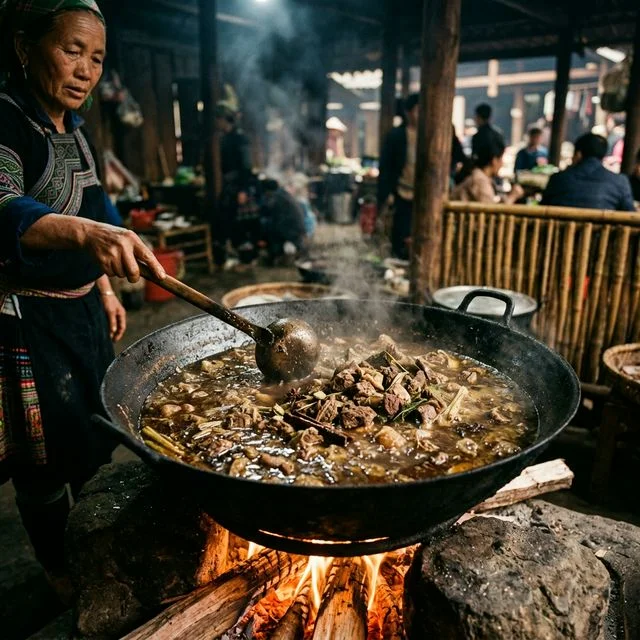
In Sapa, food is much more than sustenance — it is an invitation to understand the H'Mông, Dao, Tày, and Giáy cultures that have shaped these mountains for centuries. Each dish carries a story, each flavor holds the memory of a people. Here are the seven specialties we recommend every traveler try during their stay.
What is thang co, Sapa's most iconic market dish?
Thang co is a traditional H'Mông stew made from horse or buffalo meat and offal, slow-simmered with over twenty mountain spices in a large communal cauldron at ethnic markets.
At Sunday ethnic markets — in Sapa as well as in Bac Ha — thang co cauldrons have been simmering since dawn. The smell is bold, the flavors even bolder. The broth, thickened by hours of slow cooking, is fragrant with cardamom, lemongrass, mac khên (forest pepper), and ginger. It is a communal dish, eaten standing up, often accompanied by local corn rice wine.
We encourage you to try it with an open mind: thang co can be unsettling at first approach, but it remains one of the most authentic culinary experiences Sapa has to offer. If you prefer a gentler introduction, some restaurants in the town center offer a version made with beef only.
Why is com lam (bamboo sticky rice) so beloved in the mountains?
Com lam is glutinous rice steamed inside a fresh bamboo tube over hot coals, which gives it a uniquely delicate bamboo fragrance with subtle smoky undertones.
This ancestral technique, practiced by the Tày and Thái ethnic groups, transforms simple sticky rice into something truly memorable. During cooking, the bamboo releases its vegetal freshness into the rice, while the charcoal heat develops a light smokiness on the outer layer. The tube is cracked open, the inner membrane peeled away, and the warm rice eaten with vegetables or grilled meat.
Com lam is easily found in the lanes around Sapa market, sold as a takeaway snack for a few thousand dong. It makes the perfect trail food during a hike through the Muong Hoa Valley.
How do local ethnic minorities prepare smoked buffalo meat (thịt trâu gác bếp)?
Smoked buffalo is buffalo meat marinated in mountain spices and hung above the family hearth for several months, slowly acquiring a deep, smoky, and intensely savory flavor.
This is one of the most distinctive preserved foods of northern Vietnam's highlands. After marinating in garlic, chili, ginger, and mac khên, the cuts of meat are suspended in the family kitchen, where the smoke from daily fires slowly dries them over six months to a year. The result is dark, dense meat with a remarkable woodsmoke and spice intensity.
It is eaten sliced thin and gently warmed in a pan or over coals. We particularly recommend it with a glass of local rice wine in the evening, as the mountain chill sets in.
What is Sapa's black pork (thịt lợn cắp nách) and where can you try it?
Sapa's black pork is a small free-range pig raised by H'Mông families, grilled whole over wood fire, prized for its crispy skin and exceptionally flavorful, lean meat.
The name "cắp nách" (literally "carried under the armpit") refers to the tradition of minority people bringing these small ten-kilogram pigs tucked under their arms to market. Raised outdoors on wild plants and corn, these animals develop firm, fragrant meat with very little fat. Slowly grilled over a wood fire, black pork is served with sticky rice and fresh mountain herbs.
The Sapa night market and several restaurants on Cầu Mây street serve it regularly. It is one of the dishes our guides unfailingly recommend during our 3-day Sapa tours.
Why does Sapa's salmon hotpot surprise so many visitors?
Sapa's salmon hotpot (lẩu cá hồi) is a herb-infused mountain broth in which locally farmed salmon is cooked at the table, served with vegetables and rice noodles.
Sapa sits at nearly 1,600 meters above sea level, in a region of cold, pure-flowing waters. These conditions are ideal for salmon and sturgeon farming, an industry that has grown steadily over the past twenty years along the rivers of Lào Cai province. The result is firm, flavorful fish of outstanding freshness.
The salmon hotpot is especially appreciated in the evening when temperatures drop to 10–12°C in winter. The light broth, perfumed with lemongrass and kaffir lime leaves, enhances the fish's delicacy without overpowering it. Many restaurants in the center of Sapa also offer sturgeon hotpot, which has a more robust flavor.
What is seven-color sticky rice (xôi bảy màu) in Sapa?
Xôi bảy màu is a festive seven-colored sticky rice, naturally dyed using forest plants and leaves, traditionally prepared by the Nùng Dín ethnic group for celebrations and offerings.
Dragon-fruit red, indigo purple, turmeric yellow, forest-leaf green, gac orange — each hue comes from a different plant, with no artificial coloring. This ceremonial rice is more than food: it is a symbolic offering prepared during major celebrations to honor ancestors and bring good fortune. You will find it on certain stalls at morning ethnic markets, presented in colorful bundles wrapped in banana leaves. It is eaten plain or lightly sweetened with sesame.
Why are the Sapa night market grills an unmissable experience?
Sapa's night market grills bring together smoked tofu, wild mushrooms, corn, and marinated meats cooked over hot coals in a warm, convivial outdoor atmosphere right in the town center.
From 6pm onward, Sapa's night market comes alive along the central square. Dozens of small metal braziers spread their warmth and aromas through the cool mountain air. Vendors grill firm local tofu, mountain mushrooms (the nấm hương variety in particular, with its deep fragrance), corn, purple sweet potatoes, and skewers of mac khên-marinated pork or buffalo.
It is not fine dining in the traditional sense, but a complete experience in itself. You eat standing, chat with vendors, and watch H'Mông women in traditional dress moving through the crowd. It is one of the scenes of daily life in Sapa that we most love sharing with our travelers.
How can you plan a culinary journey during your stay in Sapa?
To truly taste Sapa's specialties, the best approach combines a morning ethnic market, a com lam break on a hike, and an evening at the night market over two days.
Here is our suggested food itinerary:
| Time | What to try | Where |
|---|---|---|
| Morning Day 1 | Seven-color sticky rice, com lam | Morning market, Sapa |
| Lunch Day 1 | Grilled black pork, smoked buffalo | Local restaurant, Cầu Mây street |
| Evening Day 1 | Assorted grills | Sapa night market |
| Morning Day 2 | Thang co | Ethnic market (Sunday) |
| Evening Day 2 | Salmon hotpot | Restaurant in Sapa town center |
These addresses and moments are something we naturally weave into every tour we design. For us, food is as much a gateway into minority cultures as hiking or visiting villages.
Want to experience this in Sapa?
Parfum d'Automne, our local expert agency, designs tailor-made itineraries that go beyond the beaten track. We bring the best of our blog into your custom journey.