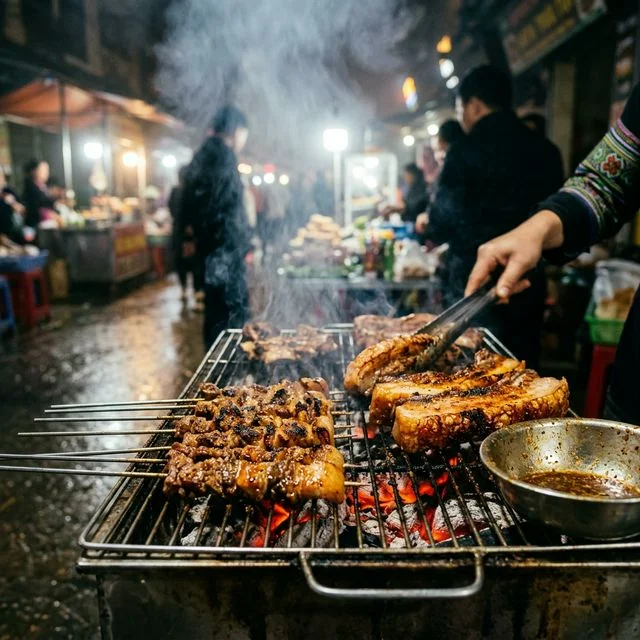
In Sapa, one dish keeps coming up in travelers' stories from the night market: grilled black pork, or lợn cắp nách. Behind this curious name lies a rustic meat, slow-grilled over a wood fire by Hmong and Dao families, and now one of the region's most sought-after specialties. Here's everything worth knowing before you try it.
What is "lợn cắp nách", Sapa's famous black pig?
Lợn cắp nách is a small black pig from Northern Vietnam's mountains, traditionally carried under the arm to the market.
Its name literally means "the pig carried under the armpit," a practice still visible today at ethnic markets: Hmong and Dao families arrive with their animals tucked into bamboo cages, slung over a shoulder or wedged under one arm because the animal stays so small. An adult black pig rarely weighs more than ten kilograms, a far cry from lowland industrial farms.
Pointed snout, short ears, black coat and coarse bristles: this hardy breed looks nothing like the pink pigs familiar to European travelers. We often describe it to our travelers as the symbol of a mountain agriculture that has stayed true to its habits, far from conventional food supply chains.
Where does this breed come from and how do local ethnic groups raise it?
Raised semi-free around Hmong and Dao houses, this hardy pig forages on its own and grows slowly, without any industrial feed.
Unlike intensive farming, lợn cắp nách lives outdoors, foraging between the houses: kitchen scraps, roots, tubers and wild plants make up most of its diet. This freedom of movement, combined with slow growth, largely explains the meat's distinctive texture, firmer and leaner than a conventionally farmed pig.
Lively and tough like a wild boar, it rarely falls ill, which makes it a valued animal for local families, prized as much for its resilience as for its taste. At Sunday markets, it's common to meet sellers from remote villages bringing only two or three animals, the result of small-scale family farming.
How do Hmong and Dao families prepare charcoal-grilled black pork?
The meat is marinated with mountain spices, sometimes stuffed with mushrooms, then slowly grilled over charcoal embers.
The traditional preparation takes time and real skill, passed down through generations in Hmong and Dao households. Every step matters to achieve crisp skin and meat that stays tender all the way through.
The marinade and mushroom stuffing
Before grilling, the meat is rubbed with a mix of salt, fresh ginger, lemongrass and sometimes forest honey to caramelize the skin. For whole pieces, such as a young roasted pig prepared for a village celebration, the cavity is filled with fragrant mushrooms and wood ear fungus, which infuse the meat from the inside during cooking.
Slow cooking over charcoal
The meat is then grilled over a moderate wood fire, never too intense, giving the fat time to render without burning the skin. The pieces are regularly turned and basted, a gesture we've watched repeated dozens of times during our visits to villages around Sapa. The result: golden, slightly crackling skin contrasting with juicy meat carrying a light smoky flavor.
What does black pork taste like, and which cuts should you try?
The meat is firm and lean, closer to game than farmed pork; ribs, belly and offal are the most sought-after cuts.
The first thing our travelers notice: this isn't the melt-in-your-mouth texture of conventionally farmed pork. Lợn cắp nách meat is denser, slightly more muscular due to free-range rearing, with a flavor that sometimes recalls game or wild boar. This makes it popular among fans of distinctively flavored meats, though it can surprise palates used to fattier, more tender pork.
Connoisseurs go first for the grilled ribs, crispy and easy to share, followed by the belly, fattier and richer. Offal, prepared as sausage or simply grilled, traditionally rounds out the plate for those seeking the full culinary experience.
Where and at what price can you try authentic grilled black pork in Sapa?
Xuân Viên street and the area around the night market host the best addresses, with meals typically costing between 100,000 and 300,000 VND.
Several neighborhoods in Sapa have specialized in this dish over the years, each with its own atmosphere. Here's how we usually present them to travelers:
| Where to eat | Atmosphere | Authenticity | Typical price |
|---|---|---|---|
| Xuân Viên street, central Sapa | Specialized restaurants, lively terraces | Good, generous portions | 150,000 - 300,000 VND |
| Sapa night market | Street stalls, friendly atmosphere | Very good | 80,000 - 150,000 VND |
| Sunday village markets (Can Cau, Bac Ha) | Authentic, outdoors | Maximum | 60,000 - 120,000 VND |
For a full experience, we recommend trying a street-food version at the night market first, more affordable and spontaneous, before booking a table at a Xuân Viên street restaurant if you'd like a heartier portion with proper seating. If you're looking for other reliable places to eat local food without any surprises, we've put together our selection of the best restaurants for local food in Sapa, where several addresses serve their own version of grilled black pork.
When and how should you fit this tasting into your Sapa trip?
Grilled black pork is available year-round, best enjoyed in the evening, alone or shared around a table with others.
Unlike more seasonal dishes, grilled black pork is available in Sapa all year, though it's especially appealing on cool evenings when the grilled meat and its light smoky flavor really come into their own. It's also a naturally shareable dish: most restaurants serve portions meant for two to four people, alongside sticky rice and fresh mountain herbs.
Our local guides know which addresses work with meat that's fresh that day, an essential detail for enjoying this specialty without any bad surprises. If you're traveling with us, we're happy to weave this kind of authentic culinary experience into your itinerary, between two treks through the rice terraces.
Want to live this experience in Sapa?
Parfum d'Automne, our expert local agency, designs off-the-beaten-path itineraries for you. We weave the gems from our blog directly into your tailor-made trip.