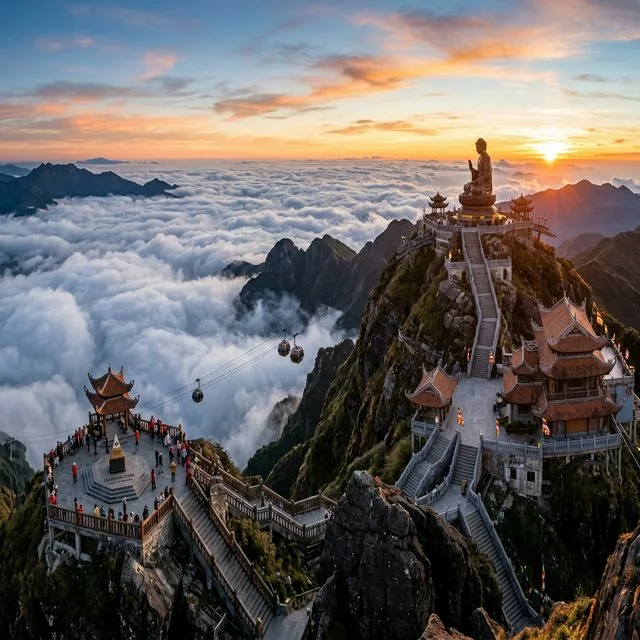
At 3,143 metres above sea level, Fansipan is the highest peak in Indochina. From Sapa, two routes lead to its summit: the Sun World cable car, fast and spectacular, or a multi-day forest trek, demanding and unforgettable. Which should you choose? It depends entirely on what you're looking for.
What is Mount Fansipan and why is it so iconic?
Fansipan, Vietnam's highest peak at 3,143 m, is the rooftop of Indochina, reachable from Sapa by cable car or on foot over two days of trekking.
Nicknamed the "Roof of Indochina," Fansipan belongs to the Hoàng Liên Son range, about fifteen kilometres from central Sapa. For decades, only experienced trekkers could attempt to climb it. Since 2016 and the opening of the Fansipan Legend cable car by Sun World, the summit has become accessible to everyone — in under twenty minutes.
This democratisation has transformed how people approach Fansipan: two radically different experiences now coexist. One offers ease and views; the other offers effort and forest. Neither is objectively better — it all depends on your travel priorities.
How does the Fansipan Legend cable car work?
The Fansipan Legend cable car links Sapa station to the summit in 15 to 20 minutes, covering a 1,410-metre elevation gain over 6.3 kilometres of cable.
The lower station sits about 3 km from central Sapa, reachable on foot or by taxi. From there, a panoramic gondola sweeps you above the high-altitude forests and misty valleys to the summit station at 3,143 metres. You'll then need to climb roughly 600 stone steps — or take an optional indoor funicular — to reach the iconic summit stele.
The Sun World site around the upper station also includes pagodas, Buddhist gardens and viewpoints that make the visit a cultural experience in its own right.
Cable car hours and prices in 2026
The cable car runs daily, generally from 7:30 am to 5:30 pm. Current fares are as follows:
| Option | Adult fare | Child fare (1m–1.4m) |
|---|---|---|
| Cable car (Mon–Fri & Sun) | 850,000 VND (~$35) | 550,000 VND |
| Cable car (Sat & public holidays) | 900,000 VND (~$37) | 550,000 VND |
| Full combo (cable car + funicular + Peak Rail) | 1,320,000 VND (~$55) | Reduced fare available |
We recommend buying tickets online in advance, especially at weekends and during Vietnamese public holidays, to avoid long queues.
What you'll see — and what you might not
The cable car glides over vertiginous scenery. On clear days the views are breathtaking. But Fansipan is often shrouded in clouds: outside the dry months (October to April), thick mist can reduce visibility to zero. We frequently see travellers who didn't anticipate the weather return disappointed — something a little planning can easily prevent.
What does trekking to the Fansipan summit actually involve?
The Fansipan trek takes 2 days with one night in a mountain shelter, covering 11 to 19 km depending on the route, through primary forest and alpine zones.
Three main routes exist: Tram Ton (the most popular, starting from the pass 15 km from Sapa), Sin Chai (wilder and less crowded) and Cat Cat (the longest). In every case, a licensed local guide is compulsory — and genuinely essential on the ground. An entry permit for the Hoàng Liên National Park is also required.
Physically, the trek is demanding. The positive elevation gain exceeds 1,300 metres, the terrain is often slippery, and the two-day itinerary requires a solid level of fitness. In return, you'll walk through rhododendron forests in bloom in spring, misty bamboo groves, and moss-covered high-altitude zones — landscapes the cable car simply doesn't show.
The night is spent in a basic but welcoming mountain shelter. At dawn, if the sky is clear, you'll watch the sun rise from the rooftop of Indochina — a moment our local guides consider one of the finest experiences northern Vietnam has to offer.
To discover other ways to experience Sapa in depth, see our guide to activities and hikes around Sapa.
Cable car or trekking: how do you decide?
The cable car suits families and time-pressed visitors; trekking is ideal for independent hikers seeking full immersion in Fansipan's natural environment.
Here is a direct comparison to help you choose:
| Criterion | Cable car | Trekking |
|---|---|---|
| Duration | Half day | 2 days (1 night) |
| Physical effort | Low (600 steps) | High (1,300 m elevation) |
| Budget | ~$35–55 per person | ~$150–250 all inclusive |
| Nature immersion | Limited | Total |
| Suitable for children | Yes | Not recommended |
| Atmosphere | Tourist site, developed facilities | Wild, primary forest |
Our field advice: if you only have one day in Sapa or are travelling with young children, choose the cable car. If you have two extra days and good physical fitness, trekking remains a transformative experience that no gondola can replicate.
What is the best time to climb Fansipan?
The best time to climb Fansipan is October to April, during the dry season, when views are clearest and weather risks are at their lowest.
Outside this window, the monsoon from May to September brings daily rain, muddy trekking trails and near-zero summit visibility. The cable car runs year-round, but it's not uncommon to ride up into cloud and see nothing.
Winter (December–February) offers a special experience: summit temperatures can drop below zero, and in particularly cold years, snow and frost appear on the ridges. Spectacular, but requiring serious cold-weather clothing.
Spring (March–April) is the ideal time for trekking: rhododendrons are in bloom in the forest, temperatures are mild and the trails less muddy than during the rainy season.
Ready to experience Sapa for yourself?
Parfum d'Automne, our local expert agency, designs tailor-made itineraries that go beyond the tourist trail. We weave the highlights from our blog into your personalised journey.