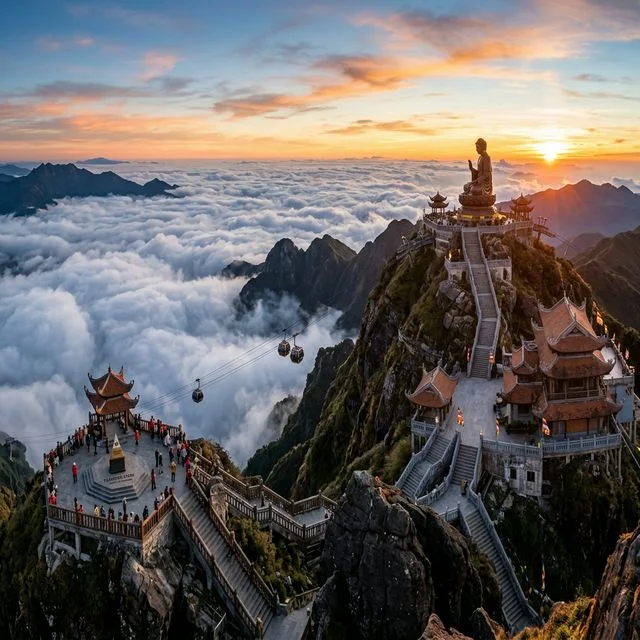
On the roof of Indochina, at 3,075 metres above sea level, a bronze silhouette rises above the clouds and primary forests of the Hoàng Liên Son massif. The Great Amitabha Buddha of Fansipan is more than a world record — it is a place of contemplation and rare beauty that leaves a lasting impression on every visitor who makes the journey.
What is the Great Buddha of Fansipan?
The Amitabha Buddha statue on Fansipan is a 21.5-metre bronze monument erected at 3,075 metres altitude, officially recognised by Guinness World Records as the highest bronze statue in Asia.
Inaugurated in 2015, this monumental work stands west-facing on a lotus-shaped pedestal eight metres tall. Amitabha — the Buddha of Infinite Light in the Mahāyāna Buddhist tradition — embodies compassion and wisdom. At this altitude, enveloped in mist and silence, the statue exerts an extraordinary presence that is hard to put into words.
The statue weighs 62 tonnes. It was cast from thousands of copper plates, each 5mm thick, assembled over an iron frame — a technique never previously used in Vietnam. Sacred Buddhist relics have been solemnly placed inside, deepening the spiritual significance of the site for Vietnamese pilgrims and international travellers alike.
The complex is laid out across three levels: at the top, the Buddha on his lotus throne; on the intermediate level, a hall dedicated to Buddhist teachings; at ground level, a visitor area with vegetarian dining — a simple and peaceful space to rest after the climb.
How do you get to the Great Buddha from Sapa town?
The fastest way to reach the Great Buddha is the Sun World cable car, which connects the Muong Hoa Valley to the Fansipan summit in around 15 minutes.
The lower cable car station is about 3 km from Sapa town centre, easily reachable by taxi or motorbike taxi. Each gondola carries 30 to 35 passengers and offers breathtaking views over the terraced rice fields and ancient forests of the massif below. The ride itself is a memorable experience.
Once at the upper station (around 3,000m), visitors face roughly 600 stone steps to reach the Buddha complex. This pedestrian path winds past temples, pagodas and carefully tended flower gardens — a climb that is very much worth the effort, even if your legs disagree at altitude.
For those who prefer to earn the summit on foot, we also guide trekking groups along the historic routes to the peak. Our article on the 3 trekking routes to the Fansipan summit covers the options, durations and difficulty levels in full detail.
What else is there to see on the Fansipan Legend complex?
Beyond the Great Buddha, the Fansipan Legend complex includes Buddhist temples, flower gardens, 600 stone steps and sweeping 360° panoramas across the entire Hoàng Liên Son range.
The site has been developed with genuine care. Several temples line the path to the statue, including a collection of pagodas inspired by traditional Vietnamese architecture. Hundreds of stone steps, flanked by hydrangeas and — depending on the season — blooming wildflowers, guide visitors upward in an atmosphere of quiet reverence.
In spring, between March and April, wild azaleas and cherry blossoms carpet the hillside around the trail. In autumn, when the morning mist clears, the view down into the Muong Hoa Valley and across the mountain ridges is simply extraordinary. These are the two best windows of the year for a visit.
We recommend setting aside at least 3 to 4 hours on site: return cable car, the stair climb, a visit to the temples and time for quiet reflection at the statue. Leaving early — before 9am if possible — greatly improves your chances of clear skies and helps you avoid the midday crowds.
When is the best time to visit the Great Buddha on Fansipan?
Autumn (September to November) and early spring (March to April) offer the best conditions for visiting the Great Buddha on Fansipan, with clear skies and pleasant temperatures.
At Fansipan's summit, the weather is unpredictable year-round: mist can roll in within minutes, even on a bright day. That said, some seasons are consistently more rewarding than others:
| Season | Conditions | Our verdict |
|---|---|---|
| Autumn (Sept – Nov) | Clear mornings, afternoon mist, golden rice terraces | ⭐ Ideal |
| Spring (Mar – Apr) | Wildflowers in bloom, soft light, fewer visitors | ⭐ Very good |
| Summer (Jun – Aug) | Monsoon rains, frequent cloud cover, reduced visibility | ⚠️ Variable |
| Winter (Dec – Feb) | Possible frost, mystical atmosphere, very cold | 🧥 Dress warmly |
Whatever season you choose, we always recommend bringing a waterproof jacket and warm layers. The temperature difference between Sapa town (1,600m) and the Fansipan summit can reach 10 to 15°C. Even in summer, it rarely exceeds 15°C at the top.
Ready to experience Sapa for yourself?
Parfum d'Automne, our local expert agency, crafts tailor-made itineraries that go beyond the beaten track. We weave the best of our blog recommendations into your personalised journey.