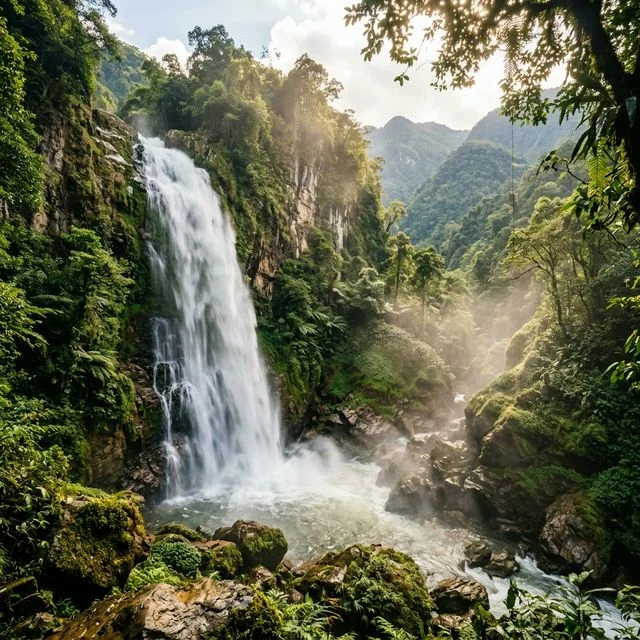
In Sapa, the mountains can change their mood in minutes. Bright sunshine in the morning, thick fog and heavy rain by afternoon — the weather in this corner of northern Vietnam is among the most unpredictable in all of Southeast Asia. Preparing well is not just a matter of comfort; it is a genuine safety issue.
Why is the weather so unpredictable when trekking in Sapa?
At 1,500 metres above sea level, Sapa has a mountain microclimate where sunshine, fog and rain can follow each other within a few hours, regardless of the season.
Nestled in the foothills of the Hoàng Liên Sơn range, Sapa sits at the convergence of several climatic forces: its high altitude, its proximity to the humid valleys of the Chinese province of Yunnan, and the complex topography of the ridgelines all combine to create a microclimate unlike anywhere else in Vietnam. Fog can roll in suddenly mid-morning even under an otherwise clear sky, and can persist for several days at a stretch during winter.
Contrary to what you might assume, weather variations occur throughout the year. In the dry season (March to May), mornings are often crisp and clear, but afternoon thunderstorms can build quickly from early summer onward. In the rainy season (June to September), trails turn to mud and slipping becomes a constant risk.
| Period | Typical conditions | Main risks |
|---|---|---|
| Dec. – Feb. | Cold (2–10°C), dense fog, frost at altitude | Hypothermia, icy trails |
| Mar. – May | Mild (12–20°C), variable sunshine, possible storms | Sudden fog, strong UV |
| Jun. – Aug. | Warm (18–25°C), frequent rain, high humidity | Muddy trails, slipping, leeches |
| Sep. – Nov. | Cool (12–22°C), residual showers | Morning fog, still-wet ground |
What gear should you pack for a safe trek in Sapa?
Essential trekking gear for Sapa includes waterproof hiking boots, a packable rain jacket, thermal layers, and SPF 50 sunscreen — even in summer.
The golden rule we follow with every group we guide is the layering principle: it is always better to remove a layer when the sun comes out than to suffer from the cold when the wind picks up on a ridgeline. Here is what we always recommend packing:
- Waterproof hiking boots — The trails in the Muong Hoa valley can be extremely muddy. Basic trainers offer neither the grip nor the ankle support needed. Look for mid-cut boots with a Vibram or equivalent sole.
- Lightweight, packable rain jacket — Non-negotiable in any season. A Gore-Tex membrane jacket compresses into a fist-sized ball and can salvage your entire day when a shower arrives without warning.
- Warm mid-layer — A light fleece is sufficient in spring and autumn. In winter, add a synthetic down jacket that can handle moisture.
- Waterproof trekking trousers — Especially important during the rainy season, they protect against leeches and scratches in bamboo-dense areas.
- Trekking poles — Invaluable on slippery descents. They dramatically reduce the risk of falls on wet terrain.
- Sunscreen SPF 50+ — Altitude amplifies UV rays, even on overcast days. Mountain sunburn happens faster than at the beach.
- Insect repellent — Below 1,000 m (in villages like Ta Van and Lao Chai), dengue fever is a genuine risk. Cover your arms and legs after sunset.
- Waterproof pack cover — To keep your dry clothes, phone and camera safe from sudden downpours.
What are the real dangers on Sapa's trails?
The main hazards when hiking in Sapa are slippery wet trails, disorienting fog, leeches in the rainy season, and potential falls on steep stone-paved descent paths.
In practice, the accidents we most often see are not dramatic: they are falls on wet stone steps, ankle sprains on steep downhill sections, or hikers who lose the path in thick fog. A few specific hazards to keep in mind:
- Rice terrace stone steps — Beautiful in photographs, they become treacherously slippery in rain or morning dew. Plant your foot flat and rely on your poles.
- Stream crossings — During the rainy season, fords can rise very quickly. Never attempt a crossing if the current looks strong.
- Leeches — Mostly present between June and September in wet, forested areas. They are not dangerous, just unpleasant. Tucking trousers into socks and carrying a little salt is usually enough to deter them.
- Disorientation in fog — Trails around Sapa are not all clearly marked. Without a guide or a downloaded offline map, it is easy to wander onto a side path leading to a dead-end village.
Is a local guide essential for trekking in Sapa?
For any trek longer than a day or in high-altitude terrain around Sapa, hiring a local guide is strongly recommended for safety, navigation and access to villages off the tourist trail.
This question comes up often: "Can we hike independently?" The short answer is yes, for short walks around the Sapa town centre. But as soon as you want to head deeper into the Muong Hoa valley or reach remote villages like Lao Chai or Ta Van, a local guide fundamentally transforms the experience.
Our Parfum d'Automne guides know every trail in every type of weather, the tricky sections to avoid after rainfall, and the local families who might welcome you for a mid-trek break. They speak the minority ethnic languages and open doors that a solo hike simply cannot. For more on our guided itineraries, take a look at our guide to activities and hiking in Sapa.
What should you do when the weather turns on the trail?
When trekking in Sapa, start early to beat midday storms, check the local forecast each morning, and always leave your planned route with your accommodation before setting off.
Beyond the gear, a few simple habits make all the difference:
- Start early. Mornings are generally clearer. Summer storms typically build between 1 p.m. and 4 p.m. Starting your trek at 7 a.m. gives you the best conditions and gets you back before the heaviest rain.
- Check the local weather every morning. Apps like Weather Underground or Windy offer valley-level forecasts. Sapa has its own weather page on several Vietnamese local sites.
- Leave your itinerary at your accommodation. A simple habit that can prove vital if you are late returning. Note your starting point, destination and expected return time.
- Turn back without hesitation. On the high ridges, if fog descends rapidly or the sky darkens, heading back is always the right decision. The mountain will still be there tomorrow.
- Stay hydrated. Altitude and physical effort both increase fluid needs. Carry at least 1.5 litres per person for a half-day walk.
At Parfum d'Automne, we always remind our groups that caution takes nothing away from the pleasure of trekking — it guarantees it. A well-prepared hike in Sapa remains one of the most memorable experiences northern Vietnam has to offer.
Ready to experience Sapa for yourself?
Parfum d'Automne, our local expert agency, crafts tailored itineraries that take you beyond the tourist trail. We bring the insights from our blog straight into your personalised journey.