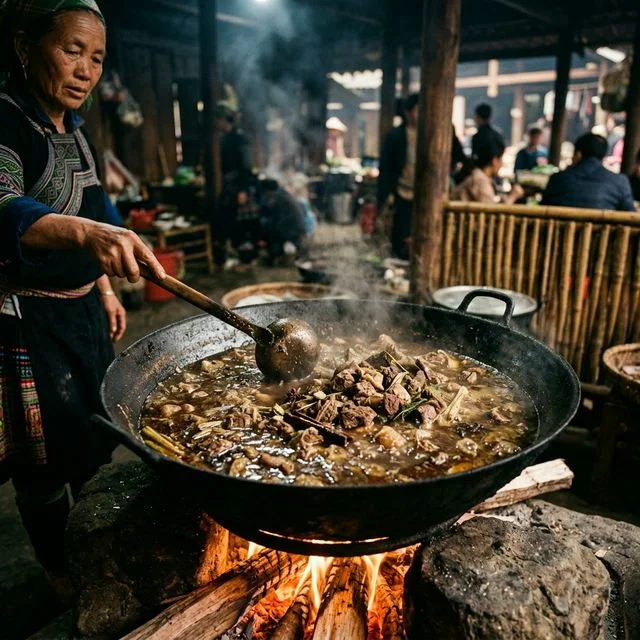
At Sapa's markets, one large simmering pot never fails to catch travelers' attention: thang co, a H'Mong stew of meat and offal that intrigues as much as it fascinates. Should you give in to curiosity? Here is everything we know about this dish, so you can decide with full knowledge of what to expect.
What exactly is thắng cố, the iconic stew of Northern Vietnam's markets?
Thắng cố is a traditional H'Mông stew made with meat and offal, slow-simmered for hours with a dozen mountain spices.
Ask anyone about Sapa's food scene and this dish comes up in every conversation, usually followed by a grin or a grimace depending on who tried it. Thắng cố holds a unique place at the table: neither starter nor single course, it's shared communally around a large pot that simmers over a wood fire for hours. The broth, thick and hearty, blends meat, offal and a long list of mountain spices that give it its distinctive fragrance.
We always introduce it to our travelers with the same honesty: this isn't a dish designed to ease Western palates gently into Vietnamese cuisine. It's a direct doorway into H'Mông culture and some of its most authentic culinary traditions.
Where does this dish come from, and why does it still matter so much to the H'Mông?
Born among the H'Mông highlanders, thắng cố made use of every part of the animal during family celebrations and market days.
The name likely comes from "thoẩng cố", roughly meaning "pot of meat" in the H'Mông language. Originally, the dish was made with horse meat, since horses were precious animals in the northern mountains, used for transport and farm work. Cooking an old or sick horse into thắng cố meant nothing went to waste: meat, offal, bones and blood all went into the pot together.
The dish was traditionally prepared during village festivals, weddings or the big Sunday markets, when several families gathered around the same cauldron. Today, at ethnic markets like Cao Son or Bac Ha, that communal spirit is still very much alive: people eat standing up, chat with strangers, and share a bowl that turns them, for the length of a meal, into fellow diners.
What ingredients and spices actually go into thắng cố?
Thắng cố combines meat, offal, bones and blood, simmered with around a dozen mountain spices including the signature thắng cố leaf.
The recipe varies slightly from village to village, but the dish's structure stays constant: a main meat, offal, and a spice blend that gives the broth its characteristic depth.
Horse, buffalo or pork?
Historically made with horse meat, thắng cố is now also cooked with buffalo, beef or pork, especially in restaurants in central Sapa that offer a milder version for travelers less used to offal. If you want to try the most traditional version, head to the Sunday ethnic markets, where it's usually made with horse or buffalo.
The spices that define the dish
Black cardamom, star anise, lemongrass, ginger, mắc khén (the forest pepper of the northern mountains), and above all "lá thắng cố", a local aromatic leaf without which the dish would lose its identity. Added during cooking, these spices soften the intensity of the meat and offal while giving the broth its lasting fragrance.
Is thắng cố really as strong-tasting as people say?
Yes, thắng cố surprises with its intensity: powerful smell, bold offal flavor, and a rich texture, best approached with an open mind.
We prefer to be upfront with travelers who ask us before their trip: thắng cố isn't a gentle stepping stone into Vietnamese cuisine. The smell rising from the pot is intense, carried by offal and spices concentrated over hours of cooking. The taste is bold, sometimes slightly metallic due to the blood used in some recipes, and the texture can throw off first-timers to offal.
That said, many of our travelers leave pleasantly surprised, especially when they try the beef-based version, milder and served in restaurants around the town center. Our advice: start small, half a bowl is enough to get a feel for it, and pair it with sticky rice to soften the experience.
Where and when can you try authentic thắng cố in Sapa?
The most authentic thắng cố is found at Sunday ethnic markets, while restaurants in central Sapa serve their own version year-round.
Two options are open to you, depending on the level of authenticity you're after and your tolerance for bold culinary experiences. Here's how we compare them for our travelers:
| Where to try it | Authenticity | Atmosphere | Typical price |
|---|---|---|---|
| Sunday ethnic market (Cao Son, Bac Ha) | Highest | Lively, loud, outdoors | 30,000 - 60,000 VND |
| Local restaurant, Cầu Mây or Thạch Sơn street | Good, milder version | Calmer, comfortable seating | 100,000 - 300,000 VND |
| Sapa night market | Good | Buzzing, among street stalls | 50,000 - 100,000 VND |
For a fuller experience, we recommend combining both: tasting it at a Sunday market for the cultural dimension, then trying it again at a restaurant in town if you'd like a milder version. If you're looking for other reliable places to eat local food without surprises, we've put together our selection of the best restaurants for local food in Sapa, where several spots serve their own take on thắng cố.
Should you dare to try thắng cố during your stay in Sapa?
Yes, if you're curious and open to offal: thắng cố remains one of the most authentic and memorable culinary experiences in Sapa.
This isn't a dish we'd recommend to absolutely everyone without caveats, but that's exactly what makes it so memorable. Trying thắng cố at a mountain market, surrounded by H'Mông families come to sell their harvest, often says more about local culture than any lengthy explanation could. Our guides are always happy to point curious travelers to the right stalls, at the right times, for the best possible introduction to this dish.
Want to live this experience in Sapa?
Parfum d'Automne, our expert local agency, designs off-the-beaten-path itineraries for you. We weave the gems from our blog directly into your tailor-made trip.