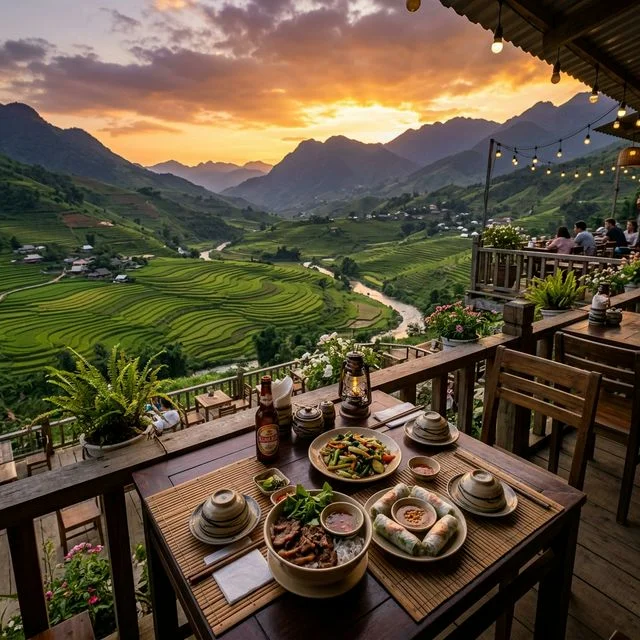
Sapa's rice terraces are among the most photographed landscapes in Southeast Asia. But to see them in their full golden splendour, timing is everything. At Parfum d'Automne, we have been guiding travellers through northern Vietnam since 2005, and the question of when to visit is the one we are asked most often.
Sapa sits at 1,500 metres above sea level in the mountains of Lào Cai province. This geography gives it a climate quite unlike the rest of Vietnam: distinct seasons, persistent mist and temperatures that can drop below 5°C in winter. Understanding the rhythm of the rice terraces — and the sky above them — is essential to planning a memorable trip.
When can you see the golden rice terraces in Sapa?
Sapa's rice terraces turn golden from mid-August to early October, with a spectacular peak in September, just before the harvest season in the Muong Hoa Valley.
This is the moment we look forward to every year. Between mid-August and early October, the rice plants reach full maturity and the terraces shift through a breathtaking spectrum — from the deep green of summer to ochre, straw yellow and then luminous gold. The effect is especially dramatic in the Muong Hoa Valley, visible from the hilltop villages of Lao Chai and Ta Van.
September is the benchmark month. The monsoon rains begin to ease, the light returns and H'Mông and Dao farmers begin harvesting by hand — a scene of authentic daily life found nowhere else. Weather conditions at this time also favour trekking: trails begin to dry out, morning mists clear faster, and afternoons often offer open skies.
If your trip is primarily planned around the golden rice terraces, we recommend targeting the window between 5 September and 5 October. This is the period we consistently recommend to our most photography-focused travellers.
What is the climate in Sapa throughout the year?
Sapa has four well-defined seasons: a mild spring, a warm and rainy summer, a bright autumn perfect for trekking, and a cold, misty winter that occasionally brings snow.
Here is the month-by-month breakdown we use when advising our travellers:
| Month | Temperatures | Conditions | Rice Terraces |
|---|---|---|---|
| January – February | 5 – 12 °C | Cold, heavy mist, occasional frost or light snow | Fields at rest, bare terraces |
| March – April | 12 – 20 °C | Mild, cherry and plum blossoms, some mist | Flooded terraces (mirror effect) |
| May – June | 18 – 24 °C | Lush, first rains, vivid vegetation | Bright green terraces, transplanting |
| July – August | 20 – 26 °C | Monsoon, frequent rain, slippery trails | Deep green terraces, ripening begins |
| September – October | 16 – 22 °C | Sunny, clear skies, ideal for trekking | Golden terraces, harvest underway |
| November – December | 8 – 16 °C | Cool to cold, morning mist, winter landscapes | Harvested terraces, open mountain views |
These are averages based on years of on-the-ground observation. Sapa is a mountain destination: fog can appear at any season, and conditions can shift within a few hours. That, in many ways, is what makes every stay unique.
What is the best season for trekking in the Muong Hoa Valley?
Autumn, from September to November, offers the best trekking conditions: dry trails, comfortable temperatures between 15 and 22°C, and excellent visibility across the surrounding peaks.
Trekking is the signature activity in Sapa, and the conditions you experience along the way make all the difference. During summer, the dirt tracks that wind through the Muong Hoa Valley become muddy and slippery under the monsoon rains. Falls are common, and some routes may be temporarily closed due to landslides.
In autumn, everything changes. The rains ease, the trails firm up, and the viewpoints from the ridgelines regain their clarity. This is when we organise our most ambitious trekking itineraries — out to Lao Chai and Ta Van, or deeper into the valleys to the quieter villages of Ban Ho and Sa Seng. With mild days and cool evenings, the physical effort feels more manageable, and nights in homestays take on a particularly warm and convivial character.
Spring (March to May) is an excellent alternative for travellers who prefer to avoid the high season. The terraces are flooded before planting, creating a striking mirror effect that reflects the sky and mountains above. Temperatures remain pleasant, trails are passable and crowds are thinner than in September. To plan your visit by season, our complete guide on when to visit Sapa covers all the details, updated every season.
What can you do in Sapa outside of the golden rice season?
Sapa is worth visiting all year round: each season reveals a different side of the mountain, from encounters with ethnic minority communities to the snow-dusted peaks of Fansipan in winter.
This is a point we always make: Sapa is not a destination to visit only for its golden rice terraces. It reveals itself in very different ways depending on when you arrive.
In winter, between December and February, the cold transforms the mountain. Fansipan — the Roof of Indochina at 3,143 metres — can be dusted with snow, and the town of Sapa takes on an almost alpine atmosphere. The Sunday markets at Bac Ha, 60 kilometres away, remain lively year-round and offer genuine encounters with the Flower H'Mông in their embroidered costumes. The winter mist gives the landscape a mysterious, poetic quality that some photographers actively seek out.
In spring, wild cherry and plum blossoms bring colour to the high-altitude villages. The flooded terraces create spectacular reflections as early as April. And even in summer, despite the rain, the vegetation reaches an intense green and the waterfalls swell to their most powerful — Silver Waterfall (Thac Bac) is particularly impressive at this time of year.
Whatever the season, our local teams adapt each itinerary to make the most of the conditions on the ground. That is the real advantage of travelling with a local agency: we know Sapa in every kind of weather, and we know exactly where to take you.
Ready to experience Sapa for yourself?
Parfum d'Automne, our local expert agency, designs tailor-made itineraries that go beyond the beaten track. We bring the best of our blog directly into your custom journey.