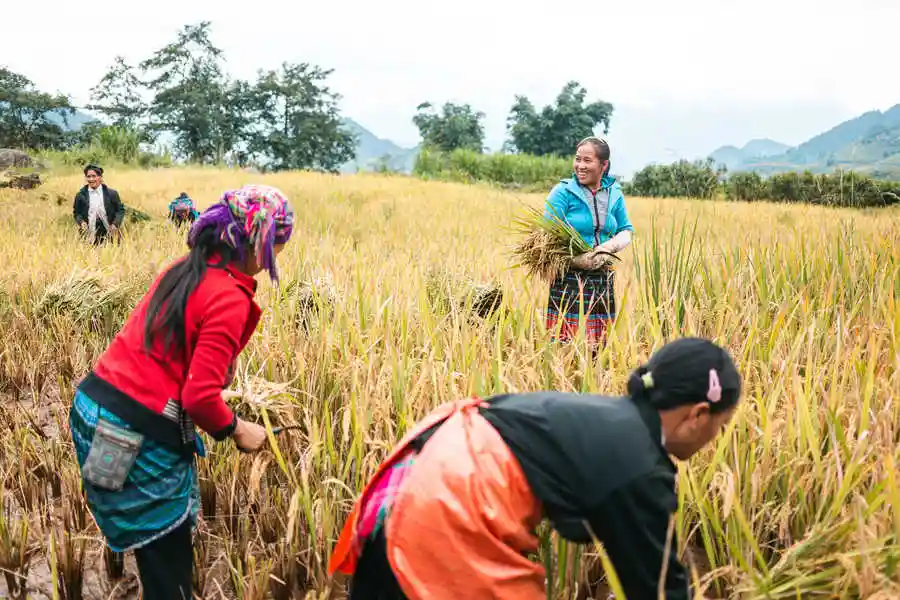
From mid-September to late October, Sapa undergoes its most spectacular transformation of the year. The terraced rice fields gradually turn golden, H'Mông communities bustle through the fields for the harvest, and temperatures remain mild before the winter cold sets in. If we had to recommend just one season to discover Sapa in its full splendour, it would be autumn without hesitation. Twenty years of accompanying travellers on the ground have convinced us that this period offers a unique alchemy: the golden light of the harvest season, the relative calm of the trails in November, and weather that lends itself to every kind of hike.
Why is autumn considered the most beautiful season in Sapa?
Autumn in Sapa, from September to November, brings golden rice terraces, clear skies and ideal temperatures for hiking and immersing yourself in ethnic village life.
The answer lies in a single image: terraces cascading as far as the eye can see, heavy with ripe amber-and-gold rice beneath an often crystal-clear October sky. This vision, which we know well from having witnessed it every year since Parfum d'Automne was founded, is not a postcard cliché — it is a reality within reach for anyone who plans their stay at the right time. The end of the monsoon, which typically wraps up in early September, clears the atmosphere and delivers remarkable light. The trails dry out quickly, views open up across Fansipan and the surrounding ridgelines. The Muong Hoa Valley becomes a living canvas, animated by families harvesting by hand, generation after generation, in conditions that have barely changed over the centuries.
Autumn is also the period when Sapa sees its highest visitor numbers — worth bearing in mind when booking accommodation. But with a little organisation, the crowds take nothing away from the quality of the experience, especially if you step slightly off the most popular paths.
What is the weather like in Sapa in autumn?
In autumn, temperatures in Sapa range from 12 to 22 °C, with generous sunshine in September and October, followed by a gradual cooling from November onwards.
Sapa's autumn divides naturally into two distinct climatic phases. From September to October, days are bright and mild: you can hike in a t-shirt through the valley in the morning before reaching for a wind jacket in the evening. Rainfall drops sharply compared to the summer season, although a few passing showers remain possible in early September. From November, temperatures fall noticeably, morning mist thickens over the ridges and some nights dip to around 8–10 °C. It is a more melancholic atmosphere, perfect for atmospheric photography, but one that calls for warm clothing.
| Month | Min. temp. | Max. temp. | Rainfall | Atmosphere |
|---|---|---|---|---|
| September | 16 °C | 22 °C | Low | Green to golden terraces |
| October | 14 °C | 20 °C | Very low | Peak golden colour, active harvest |
| November | 10 °C | 17 °C | Very low | Mist, ploughed terraces |
In November, once the harvest is complete, farmers plough the terraces and flood them to prepare for the next season. The reflections of the sky in these water mirrors create a landscape every bit as striking — though very different from October's golden tableau. For travellers avoiding the crowds, November is often the best compromise: dry weather, lower accommodation prices and quieter trails.
When exactly are Sapa's rice terraces at their golden peak?
Sapa's rice terraces reach their maximum golden colour between mid-September and mid-October, during the annual harvest in the villages of the Muong Hoa Valley.
The golden window is short — two to three weeks on average — and varies from year to year depending on weather conditions. The transformation begins in the lower sections of the valley, where rice is planted earliest. It gradually climbs towards the highest terraces, sometimes reaching 1,200 metres of altitude. In practice, if you arrive between 15 September and 10 October, you have a very strong chance of finding the terraces at their peak. Before 10 September, the rice is still green and milky. After 20 October, the harvest is usually complete in most villages and the terraces begin to be ploughed. We say it to our travellers every year: a few days of flexibility on your arrival date can make a real difference to what you see.
What is there to do in Sapa in autumn?
Autumn in Sapa is the ideal season for hiking in the Muong Hoa Valley, witnessing the harvest in H'Mông villages and attempting the Fansipan ascent under clear skies.
Hiking in the Muong Hoa Valley
The Muong Hoa Valley, which stretches some ten kilometres south-east of Sapa town centre, is the beating heart of the golden season. The main trail, accessible on foot or by bicycle, winds through the villages of Lao Chai, Ta Van and Giang Ta Chai, offering breathtaking viewpoints over the cultivated terraces. In autumn, trail conditions are excellent: the monsoon rains have left the region, the ground is firm and the rivers are calm. A full-day trek through this valley, with a picnic in a village along the way, is the experience we recommend first to all our travellers.
Witnessing the rice harvest in H'Mông villages
Between mid-September and late October, Black H'Mông, Red Dao and Tày families descend into the terraces to harvest by sickle, in solidarity groups that move from plot to plot. Witnessing this work — and sometimes joining in, if the welcome allows — is a human experience that few others can match. This is not a performance staged for tourists: it is the real life of a village waking at dawn and working until sunset. Our local guides, themselves members of these communities, know how to create the conditions for an authentic and respectful encounter.
How should you plan your stay in Sapa in autumn?
To make the most of autumn in Sapa, book your accommodation early, pack layered clothing and trust your itinerary to a local guide who knows the best weather windows.
A few practical tips we share with every traveller before departure:
- Book your accommodation early: September–October is Sapa's high season. The best boutique hotels and homestays often fill up weeks in advance.
- Dress in layers: a sunny morning at 20 °C can give way to a 12 °C evening. A lightweight windbreaker, a small fleece and waterproof walking shoes cover almost every situation.
- Build flexibility into your dates: if your tickets allow, adding one or two extra nights gives you the leeway to catch the best moment for terrace colours.
- Plan at least two nights on site: Sapa deserves far more than a day trip. Two nights allow you to alternate between hiking, village visits and rest in an exceptional mountain setting.
To organise a tailor-made stay during the golden season, consult our complete guide on the best time to visit Sapa, in which we break down month by month what you can expect to find on the ground.
Want to live this experience in Sapa?
Parfum d'Automne, our expert local agency, crafts itineraries that go beyond the beaten path. We weave the best insights from our blog into your tailor-made journey.