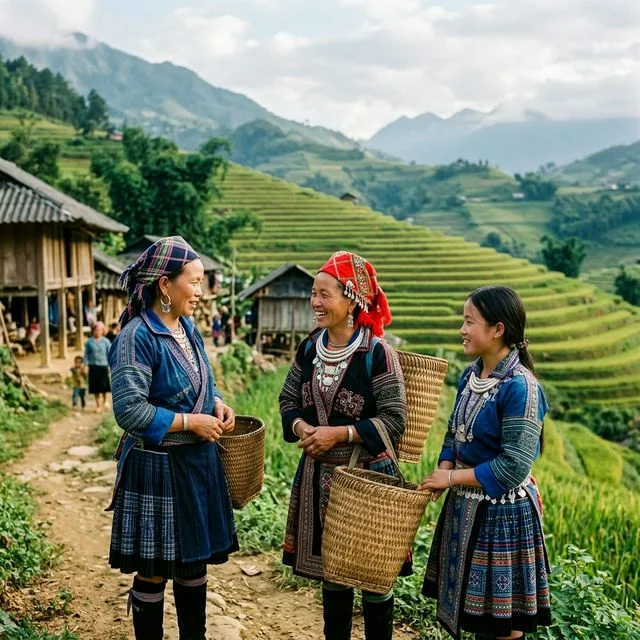
Beyond Sapa's busy streets and the well-worn paths to Ta Van and Cat Cat, there is another way to experience this region: spending the night in an H'Mong village perched above 1,600 metres, far from any urban noise. Lao Chai, Sa Seng, Hang Da — names that rarely appear in mainstream travel guides, and that is precisely what makes them worth seeking out.
Why choose an off-the-beaten-path village over a standard homestay?
Lao Chai, Sa Seng and Hang Da offer genuine immersion away from mass tourism, with H'Mong families who still live according to their centuries-old traditions.
Most first-time visitors to Sapa follow a well-established route: down into the Muong Hoa Valley, a night in Ta Van, back through Cat Cat. These places have real charm, but they now receive dozens of tour groups every day. Things shift when you venture a little further.
In Lao Chai, at the lower end of the Muong Hoa Valley, stilt houses overlook the terraced rice fields and the village still moves at a pace undictated by tourist arrivals. Sa Seng, sitting slightly higher, is reached by a ridge trail with sweeping views over surrounding valleys. Hang Da, which we consider one of the most unspoiled villages in the area, sits at around 1,800 metres in a mountain setting of remarkable calm.
All three villages are home primarily to Black H'Mong families who live from farming, livestock and a textile craft passed down through generations. Staying overnight means sharing their daily life — meals by the fire, conversations at nightfall, the sounds of the village at dawn.
How do you get to these villages from Sapa?
Lao Chai is about 8 km from Sapa town centre, reachable on foot in around 3 hours; Sa Seng and Hang Da require a full day of trekking with a local guide.
Lao Chai is the most accessible of the three. A well-worn trail drops from the centre of Sapa into the Muong Hoa Valley and reaches the village in 2.5 to 3 hours. The elevation change is moderate, though the path can be slippery in wet season — proper footwear is essential.
Sa Seng and Hang Da require more commitment. Sa Seng is typically part of a two-day circuit crossing several villages, with an overnight homestay on site. Hang Da, higher up, is often the final leg of a more demanding trek starting from Hau Thao or Giang Ta Chai. These routes should not be attempted without a guide: trails are not systematically marked and landmarks can be hard to follow.
We always recommend hiring a local guide who comes from these villages. Beyond navigation, they are the bridge between you and the host families, and their presence ensures your visit respects local customs.
What can you expect from a night in these village homestays?
A night in a homestay at Lao Chai, Sa Seng or Hang Da means a simple room in a family home, meals made from garden produce and total immersion in village life.
Comfort is basic but clean. You sleep on a mat or mattress, sometimes in a shared room with other travellers, sometimes in a small private space depending on the household. There is no wi-fi and no guaranteed hot water — and it is precisely this simplicity that makes the experience so memorable.
Meals are included in most packages. H'Mong women cook with what they grow: garden vegetables, sticky rice, black-feathered grilled chicken, corn spirit or tao meo — the wild plum liqueur traditional among the H'Mong. Portions are generous and the flavours are entirely honest.
Evenings unfold naturally around the fire. Some guides arrange an indigo batik demonstration or an embroidery session with the women of the village. Without a fixed schedule, you simply observe life: children returning from school, water buffalo brought back to the stable, neighbours passing by.
What is the best season to stay in these villages?
The ideal time to visit H'Mong villages around Sapa runs from September to November and from March to May, when trails are passable and the scenery is at its finest.
Autumn (September to November) remains our favourite season for these itineraries. The terraced fields turn gold and rust, the light is gentle and the nights cool but bearable. It also follows the main rainy season, which leaves the trails in much better condition.
Spring (March to May) offers a different spectacle: the terraces flood for rice planting, cherry and peach blossoms erupt across the hillsides. The light is sharper and more vibrant — perfect for photography.
Winter (December to February) suits travellers seeking mist and solitude — Hang Da in particular takes on a mystical atmosphere under low cloud — but nights can drop below 5°C. Summer (June to August) is not recommended for trekking: monsoon rains make trails muddy and potentially dangerous.
| Season | Conditions | Recommendation |
|---|---|---|
| March – May | Mild, flooded terraces, blossoms | ✅ Excellent |
| June – August | Monsoon, slippery trails | ⚠️ Not ideal for trekking |
| Sept – Nov | Golden terraces, stable weather | ✅ Ideal |
| Dec – Feb | Mist, cold, atmospheric | 🌫️ For solitude seekers |
How do you organise a stay in these villages with Parfum d'Automne?
Parfum d'Automne offers tailor-made circuits including an overnight homestay in Lao Chai or high-altitude villages, with a French-speaking local guide and transport included.
These villages have no independent tourist infrastructure — no booking platform, no signage. Access goes through a guide or agency with direct relationships with host families. This is the model we have practiced for years at Parfum d'Automne: our guides largely come from these valleys, and the families who host our travellers are partners we know personally.
A two-day, one-night stay is enough to reach Lao Chai comfortably. For Sa Seng and Hang Da, we recommend a minimum of three days to avoid rushing and to make the most of each stop. You can browse our Sapa tours for available options, or contact us for a fully customised itinerary.
If you are looking for an experience that genuinely stands apart — away from groups, close to village life as it is actually lived — these three destinations deserve to be at the heart of your Sapa trip, not an afterthought.
Want to live this experience in Sapa?
Parfum d'Automne, our local expert agency, designs itineraries that go beyond the obvious. We build the discoveries from our blog into your tailor-made journey.