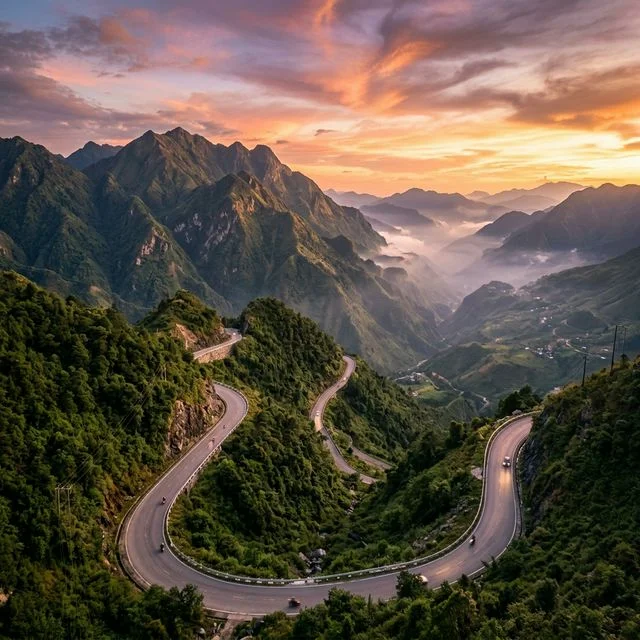
Riding through the winding mountain roads that thread between terraced rice fields and misty passes in northern Vietnam: the motorbike remains one of the most exhilarating ways to experience Sapa. But behind that freedom lie practical realities you need to know before you grab the handlebars.
At Parfum d'Automne, we have been guiding travellers in Sapa since 2005. Every year we see visitors set off on motorbikes without having prepared for the local conditions: demanding roads, rapidly changing weather and regulations that can catch you off guard. This guide brings together everything we advise them to know before renting.
Is it easy to rent a motorbike in Sapa?
Yes, motorbike rental is widely available in Sapa — many hotels, hostels and specialist shops offer two-wheelers so you can explore the region at your own pace, at very affordable prices.
The town of Sapa has a good network of rental operators, mainly concentrated in the town centre and around traveller-oriented hotels. You will find two main categories of vehicles:
- Automatic scooters (Honda Air Blade, Yamaha Freego…): easy to ride and suitable for paved roads. Expect to pay between 80,000 and 120,000 VND per day (€3 to €5).
- Semi-automatic or manual motorbikes (Honda XR150, Winner X 150, Yamaha WR155…): more powerful and better suited to steep slopes and dirt tracks. Prices range from 150,000 to 300,000 VND per day (€6 to €12).
Before signing anything, we recommend photographing the bike's existing condition (scratches, mirrors, tyres) to avoid any dispute on return. Also check the oil level, brake condition and that all lights are working properly.
Which type of motorbike should you choose for mountain roads?
For Sapa's mountain roads, a semi-automatic motorbike of at least 125cc is preferable to a scooter, which can struggle on the long climbs above 1,500 metres altitude.
The terrain around Sapa is deceptive. What looks like a simple ride on a map can quickly become a demanding ascent on narrow roads, sometimes potholed or mud-slicked after rain. Automatic scooters work fine for staying in the Muong Hoa valley or reaching villages close to the centre, but they quickly hit their limits on passes like O Quy Ho or the road to Lai Châu.
Our field advice: if you are not comfortable riding a manual motorbike, opt for a semi-automatic, which combines scooter convenience with enough power for tough sections. If you are riding for more than one day, make sure the carburettor is clean and the tank is full — petrol stations become scarce once you leave the main roads.
What documents do you need to ride legally?
To ride a motorbike legally in Vietnam, you must carry an International Driving Permit recognised by Vietnamese authorities — without it, you are breaking the law.
The rules are clear: foreign riders must hold an International Driving Permit (IDP) in the category matching the engine size of their vehicle. For a motorbike of 125cc or above, category A is required. Without this document, you risk fines of between 200,000 and 800,000 VND, as well as complications with your travel insurance in the event of an accident.
Here is what you should carry at all times:
- Your home country driving licence (valid)
- Your International Driving Permit (issued by your local automobile association before departure)
- The rental agreement provided by the operator
- A copy of your passport
On the insurance side, check your travel policy carefully before leaving home: many policies exclude motorised two-wheelers, or only cover them if the rider holds the appropriate licence. Get this confirmation in writing before you travel.
What safety precautions are absolutely essential?
In Sapa, wearing a helmet is compulsory on public roads. Mountain roads combine multiple hazards: steep gradients, hairpin bends, wet surfaces and frequent fog at altitude.
Motorbike safety in the mountains of northern Vietnam is not something to improvise. Here are the rules we always share with our travellers:
- A helmet is mandatory — and not just any helmet: for mountain roads, choose a full-face helmet or at the very least an open-face helmet with a visor.
- Wear gloves, closed shoes and long clothing: at altitude, temperatures can drop quickly, especially in the early morning and after rain.
- Ride early in the morning, when roads are clearest. Fog often rolls in during the middle of the day and can reduce visibility to just a few metres.
- Never ride at night: mountain roads are unlit, and night-time accidents are common.
- Watch out for trucks and buses, which often take the middle of the road on bends.
- Anticipate the weather: during the rainy season (June to August), some sections can become impassable. Check the forecast each morning before heading out.
Finally, some natural areas and villages around Sapa require an entrance fee. To explore the Muong Hoa valley or certain ethnic minority villages, an accredited local guide may be required. We cover all these practical details in our complete guide to planning your trip to Sapa.
What are the best motorbike routes around Sapa?
The area around Sapa offers several spectacular routes suited to different skill levels — from the Muong Hoa valley, accessible to beginners, to the O Quy Ho pass, reserved for experienced riders.
Here are the routes we recommend depending on your level and available time:
| Route | Distance | Level | Highlights |
|---|---|---|---|
| Sapa → Ta Van → Ban Ho | ~25 km | Easy | Muong Hoa rice terraces, H'Mông and Giáy villages |
| Sapa → Cat Cat → Ta Phin | ~20 km | Easy | H'Mông village, Red Dao village, traditional crafts |
| Sapa → Tram Ton Pass → Silver Waterfall | ~15 km | Intermediate | Vietnam's highest pass (2,200 m), views of Fansipan |
| O Quy Ho Pass → Lai Châu | ~50 km | Advanced | Breathtaking scenery, Route 4D, dramatic descent |
The Sapa–Ta Van–Ban Ho route is our favourite for a first day on a motorbike: the road follows the Muong Hoa valley, offers stunning views over the terraced rice fields and passes through several ethnic minority villages in an environment that remains beautifully unspoilt. It is manageable on a scooter and can easily be done in a day without rushing.
For more experienced riders, the O Quy Ho pass (also known as the Cloud Pass) is one of the most spectacular roads in Vietnam. Route 4D, which crosses it, delivers breathtaking panoramas but demands a powerful bike, good brakes and total alertness on the switchback sections.
Whatever route you choose, set off early, take water, a waterproof jacket and a fully charged phone with offline maps downloaded. Mobile coverage can be unreliable in the most remote areas.
Ready to experience Sapa for yourself?
Parfum d'Automne, our local expert agency, crafts tailor-made itineraries that go beyond the beaten track. We weave the best of our blog insights into your personalised journey.