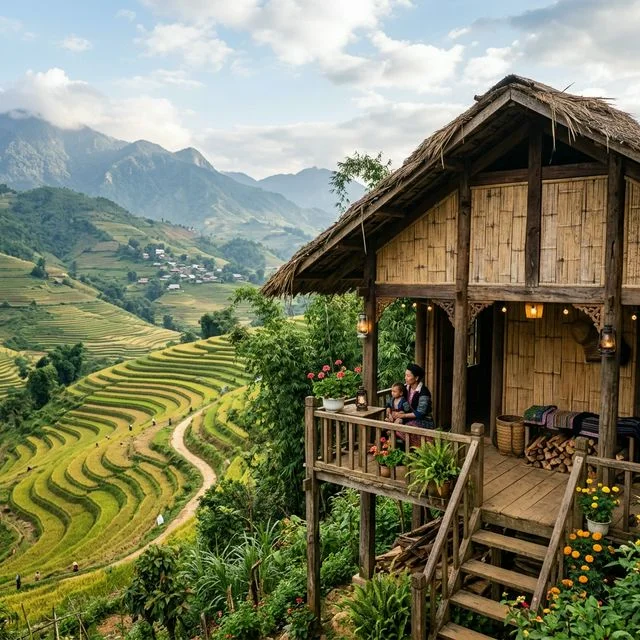
Ten kilometres from Sapa's centre, deep in the Muong Hoa Valley, the village of Ta Van moves to a rhythm that no luxury hotel can ever offer you. Sleeping in a local homestay among these terraced rice fields means accepting a rare invitation: sharing the daily life of a Giay family, eating around their fire, falling asleep to the sound of the Muong Hoa River. We bring our travellers to this village regularly, and we can tell you that none of them come back unmoved.
Where exactly is Ta Van village?
Ta Van is a village in the Muong Hoa Valley, about 10 km south of Sapa, reachable on foot in 3 hours or by motorbike taxi in 25 minutes from the town centre.
Ta Van is one of the most iconic villages in the Sapa region — not for its bustle, but precisely for its peace. It nestles at the bottom of the Muong Hoa Valley, bordered by the river of the same name and framed by rice terraces that cascade down to the water's edge. The village is home mainly to the Giay ethnic group, whose dark wooden houses and brightly embroidered costumes create a magnificent contrast with the green of the fields.
Ta Van sits at the end of the road that follows the valley from Sapa. It is also one of the key stops on the treks that pass through the villages of Lao Chai and Ta Van — an itinerary we cover in our guide to trekking in the Muong Hoa Valley. Private car access from Sapa is quick and straightforward, making it an excellent choice for families with children or travellers who want to skip the uphill walk while still enjoying a total immersion experience once they arrive.
What does a Ta Van homestay actually look like in practice?
A Ta Van homestay immerses you in the everyday life of a Giay family: shared meals, rice terraces on your doorstep, and evenings by the fire in the mountains.
The concrete experience of a Ta Van homestay is quite unlike a conventional stay. You sleep in a family home — often built from wood and bamboo — in a simple but clean room, on mats or firm mattresses. Privacy is limited, and that is precisely what makes the stay so valuable. Dinner is prepared together, with vegetables from the garden, steamed sticky rice, black chicken or pork grilled over the wood fire.
In the morning, the village stirs early. Giay women head to the fields or prepare embroidered fabrics to sell at Sapa market. Children make their way down to the village school. If you rise at dawn, you can witness this quiet ballet that gives this type of stay its entire beauty. Some families offer guided activities: an introduction to traditional weaving, a walk through the terraces with a family member, a visit to the cardamom fields. Nothing is staged. Everything is real.
What is the best season for a homestay in Ta Van?
The best time for a Ta Van homestay is September to November, when the golden rice terraces of the Muong Hoa Valley are at their most spectacular.
We tell every traveller we guide: the harvest season, between late August and October, is the most beautiful time to visit Ta Van. The terraces shift from tender green to deep gold, the morning light is extraordinary, and temperatures remain mild (15 to 22°C). It is also the most lively period in the villages: the Giay community gathers for the fieldwork, an activity that transforms every homestay into a living lesson in ethnography.
| Season | Temperatures | Landscape | Recommendation |
|---|---|---|---|
| March – April | 12 – 20°C | Freshly planted terraces, plum blossom | ✅ Very pleasant |
| June – August | 18 – 24°C | Flooded terraces, mirror effect | ✅ Very beautiful (+ humid) |
| Sept – Nov | 15 – 22°C | Golden terraces, harvest in progress | ⭐ Best period |
| Dec – Feb | 4 – 14°C | Mystical mist, occasional frost | 🌫️ Unique atmosphere |
Winter should not be dismissed either. Ta Van under the December or January mist has a particular atmosphere — almost otherworldly, and magnificent for photography. You simply need to be properly equipped: nights in village homes can be very cold.
How do you get to Ta Van from the centre of Sapa?
From Sapa, Ta Van can be reached on foot in 3 hours via Lao Chai, by motorbike taxi in 25 minutes, or by private car in under 30 minutes along the valley road.
The classic way to reach Ta Van is on foot: the Sapa – Lao Chai – Ta Van trek is one of the most beautiful in northern Vietnam. It descends through the terraces from Sapa town, follows the Muong Hoa River, winds through the bamboo houses of Lao Chai and arrives in Ta Van. Allow around 3 hours for a walker at a steady pace. A local guide who knows the shortcuts and the village families enriches the experience enormously.
If you are travelling with young children, guests with reduced mobility, or if your schedule is tight, private car is the best option. The surfaced road winding down into the valley is passable year-round and offers stunning viewpoints over the terraces. A motorbike taxi from Sapa costs around 30,000 to 60,000 VND per person.
How much does a Ta Van homestay cost, and how do you book?
A Ta Van homestay generally costs between 150,000 and 350,000 VND per person per night, often including dinner and breakfast depending on the family.
Prices remain very accessible compared to hotels in the centre of Sapa. Most homestays offer a bed + dinner + breakfast package for between 150,000 and 350,000 VND per person (approximately 6 to 15 euros). Some houses, better equipped and with private bathrooms, charge slightly more but remain very good value.
Advance booking is strongly recommended in high season (September–October and April–May), as the most popular homestays fill up quickly. In low season it is sometimes possible to arrive directly in the village, but we always recommend planning ahead to avoid disappointment. Most transactions are cash only: bring Vietnamese dong from Sapa, as there are no ATMs in Ta Van.
A few practical tips before you go
For a successful Ta Van homestay, pack warm clothes for the night, cash in Vietnamese dong, and an open mind ready to live on the village's schedule.
Here is what we always tell our travellers before heading to Ta Van:
- The nights can be genuinely cold, even in summer. The Muong Hoa Valley sits at around 1,000 m altitude. Pack a warm jacket, or even a light sleeping bag if you are travelling outside of summer.
- Internet connection is limited. This is good news: take the chance to truly disconnect. Some homestays offer Wi-Fi, but the signal is often weak.
- Respect Giay customs. Avoid touching family altars, always ask before taking photographs, and remove your shoes when entering the house.
- Bring small gifts. Pens for the children, local coffee or sweets are always much appreciated by host families.
- Pack a torch. Electricity can be intermittent and the village paths are not lit at night.
A homestay in Ta Van fits naturally into a two or three-day circuit around Sapa. We often include it in our tailor-made itineraries, combined with a hike through the valley, visits to Lao Chai village and the local ethnic markets. If you would like us to build this kind of programme for you, feel free to get in touch with us directly.
Ready to experience this in Sapa?
Parfum d'Automne, our local expert agency, designs off-the-beaten-track itineraries tailored to you. We bring the best of our blog to life in your personalised trip.