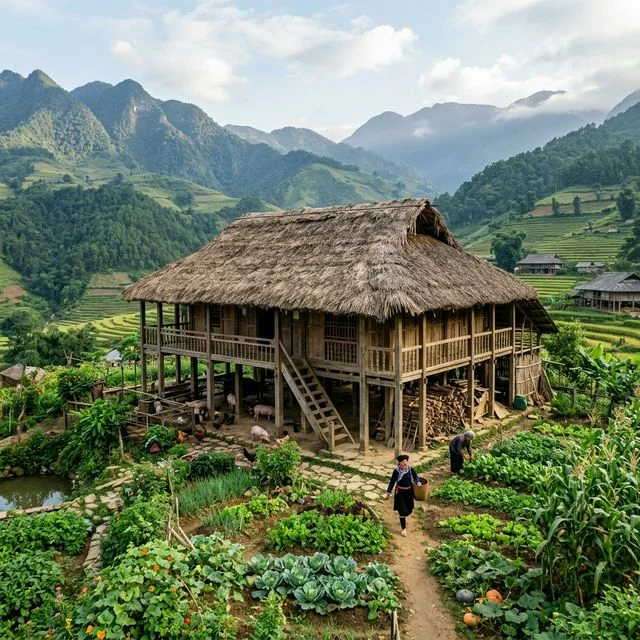
A short walk — or a few kilometres along a mountain track — is all it takes to step away from Sapa's modern hotels and knock on the door of a Black Hmong, Red Dao or Tay family. Staying with a local family is one of the most authentic experiences this region has to offer. But before you book, a few things are worth knowing.
What exactly is a homestay in Sapa?
A homestay in Sapa means sleeping in a real family home — Hmong, Dao or Tay — sharing their meals and discovering their daily life from the inside.
A homestay is not a disguised guesthouse. It is a real home, lived in by a real family, where one or several rooms have been set aside for visitors. The buildings vary depending on the ethnic group and village: dark wooden houses with the Black Hmong, large stilt homes with the Tay, modest brick buildings with some Dao families. What stays constant is the welcome: warm, straightforward, unscripted.
The immersion is total. In the evening, you share the family meal — sticky rice, garden vegetables, pork or black chicken — gathered around a fire or a shared table. In the morning, you wake to the sound of roosters and a view over the rice terraces. In between, nothing gets in the way: no hotel service, no packaged excursion. Just life in a mountain village.
It is precisely this absence of intermediaries that makes the experience so valuable. At Parfum d'Automne, we regularly include one or two homestay nights in our tailor-made Sapa tours, and these are often the nights our travellers mention first when they return.
Which villages offer the best homestay experiences near Sapa?
Ta Van, Lao Chai and Ta Phin are the three most welcoming villages for an authentic homestay within 15 km of Sapa town.
Homestay options are concentrated in the valleys and villages reachable on foot or by motorbike from the centre. Here are the three destinations we recommend most often.
Ta Van and the Muong Hoa Valley
Located at the bottom of the Muong Hoa Valley, about 8 km from Sapa town, Ta Van is a village where Giay and Hmong families live side by side amid the terraced rice fields. It is one of the most accessible villages for a first homestay stay: the paths are well marked, the host families have experience welcoming French-speaking visitors, and the setting — river, terraces, mountains — is exceptional.
Nights here are cool even in summer. Pack an extra layer regardless of the season.
Lao Chai, in the heart of Black Hmong territory
Neighbouring Ta Van and just 7 km from Sapa, Lao Chai is an almost exclusively Black Hmong village. Dark wooden houses, women in indigo clothes, the sounds of the village at dawn: the change of scenery is immediate. It is an ideal base for walkers who want to explore the Muong Hoa Valley on foot over one or two stages.
Ta Phin and the Red Dao women
Located 12 km northeast of Sapa, Ta Phin is the reference village for discovering Red Dao culture. The women here are known for their intricate embroidery and their herbal baths — an ancestral practice that several families offer their guests at the end of the day. We recommend Ta Phin particularly to travellers interested in the traditions and botanical knowledge of Vietnam's northern minorities.
How do you book a homestay in Sapa without unpleasant surprises?
Going through a reliable local agency remains the most dependable way to book a homestay in Sapa with full peace of mind.
There are several ways to book a homestay in Sapa, and not all of them are equal. Here is what we observe on the ground.
Touts at Lao Cai station or in Sapa's streets often propose homestays on the spot, sometimes in conditions that fall well short of what they describe. The quoted price does not always match what is delivered, and the host family can change from one day to the next.
Online booking platforms — Booking, Airbnb, Hostelworld — do list some reliable addresses, but filtering for "genuine" is hard to do from a distance. A property advertising itself as a homestay may in fact operate as a small guesthouse with no real family connection.
Working with a trusted local agency like Parfum d'Automne, which knows the families directly, remains the safest approach. We select our partner families on specific criteria: genuine family welcome, meals cooked by the household, and a real position within the village. We can point you to the addresses that best match your expectations in terms of comfort and immersion.
What level of comfort can you expect in a Sapa homestay?
A Sapa homestay offers simple, rustic conditions: a basic room, often a mattress on the floor, and locally cooked meals usually included.
Let's be clear: a homestay in Sapa is not a hotel. Rooms are simple, sometimes shared with other travellers, and bathrooms can be basic. Here is what you can generally expect:
| Feature | What you'll typically find |
|---|---|
| Sleeping | Firm mattress or futon on the floor, blankets, mosquito net |
| Bathroom | Cold shower or hot water depending on the family; squat toilet in some cases |
| Meals | Dinner and breakfast included in most packages |
| Electricity | Available in almost all accessible villages |
| Wi-Fi | Rare or unreliable — bring a local SIM card |
| Heating | Non-existent or minimal — blankets are your best friend in winter |
This no-frills comfort is part of the experience. Most of our travellers find it genuinely refreshing — a real break from packaged tourism. If you are concerned about comfort levels, it is perfectly possible to combine one homestay night with a night at an eco-lodge or mountain hotel.
What budget should you plan for a Sapa homestay?
Expect to pay between 250,000 and 450,000 Vietnamese dong per night — roughly 10 to 18 euros — with local meals usually included in most homestay packages.
Homestays remain the most affordable accommodation option in Sapa. Prices vary by village, season and what is included. Here are the ranges we observe on the ground in 2026:
| Package | Estimated price per person | What's included |
|---|---|---|
| Basic overnight | 250,000 – 350,000 VND (€10–14) | Accommodation + breakfast |
| Half board | 350,000 – 450,000 VND (€14–18) | Accommodation + dinner + breakfast |
| Dao herbal bath | 150,000 – 200,000 VND (€6–8) | Extra, available at Ta Phin |
These rates do not usually include transport from Sapa. If you reach the village on foot via a guided trek, the local guide is charged separately — expect 200,000 to 350,000 VND per person for a half-day.
Our tips for making the most of a homestay in Sapa
A little preparation goes a long way toward making your homestay in Sapa a memorable experience rather than just an overnight stay.
Here is what we advise all our travellers before their first homestay night:
- Bring small gifts for the children — pens, notebooks or fruit are always appreciated and create an immediate connection.
- Respect dress codes — in some communities, shoulders and knees should remain covered inside the home.
- Don't turn down the meal offered — even if you don't recognise every ingredient. Accepting food is a fundamental mark of respect for your host family.
- Ask about local customs before you arrive — among the Red Dao, for example, removing your shoes at the entrance is expected.
- Bring small-denomination cash — host families have no card reader, and ATMs are absent from the villages.
- Pack a head torch — villages are poorly lit at night, and the path between the house and the toilet facilities can be very dark.
Finally, one piece of advice that sounds obvious but is easily forgotten: slow down. A homestay in Sapa is best savoured at its own pace. Let yourself be guided by mealtimes, by the sunset over the terraces, and by conversation with your host — even when it passes through gestures rather than words.
Ready to experience Sapa firsthand?
Parfum d'Automne, our expert local agency, creates tailor-made itineraries that go beyond the tourist trail — including carefully chosen homestay nights with trusted local families.