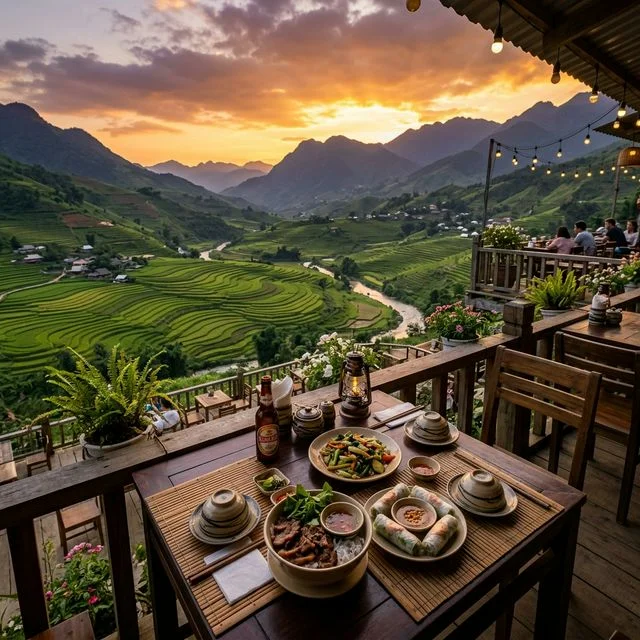
In Sapa, the most meaningful discoveries happen on foot. Walking through the Muong Hoa Valley — between the terraced rice fields, the winding mud paths, and the villages of ethnic minorities — offers an immersion that no road can match. But as you stand at a junction with no signpost and three trails heading into the mist, the question naturally arises: do you really need a local guide? After twenty years of organizing travel experiences in northern Vietnam, our answer is nuanced — and honest.
Can you explore the Sapa valley on foot without a guide?
Nearby villages like Cat Cat can be visited freely on foot, but trails toward Ta Van or Lao Chai require a guide whenever weather deteriorates or paths become unmarked.
The short answer is: it depends on your destination and your experience level. Cat Cat village, just 3 km from Sapa town, is reachable without a guide along a well-travelled and reasonably marked path. Similarly, a walk along the Tram Ton road allows you to enjoy sweeping mountain views with no need for accompaniment.
However, once you enter the Muong Hoa Valley — which stretches nearly 15 km toward Ban Ho village — the landscape changes dramatically. Paths multiply, directional signs are sparse, and muddy conditions after rain make some passages slippery and nearly indistinguishable from one another. Travellers experienced in European hiking sometimes find themselves genuinely lost on trails that all look the same. Add to this the stream crossings and makeshift bridges that require local knowledge to navigate safely.
There is also a social dimension that is easy to overlook: the terraced rice fields belong to local families. Walking through the paddies without a guide can inadvertently lead you across cultivated land or into private property. A guide acts as a social mediator — someone who knows the boundaries, both physical and cultural.
What does a local guide actually bring to a valley trek?
A local Sapa guide speaks the village dialects, knows the hidden trails, and unlocks cultural experiences that are simply out of reach for a solo traveller.
The difference between a guided hike and a solo walk is not measured only in safety — it is measured in depth of experience. Our guides at Parfum d'Automne are, for the most part, from the Black H'Mông or Red Dao communities themselves. They speak the local dialects, and that detail changes everything: stopping at a household where a grandmother is dyeing indigo thread, buying fruit directly from a farmer, sharing a meal with a family — none of these exchanges happen without an intermediary who is genuinely part of the community.
Here is what a good guide concretely provides:
- Safe navigation: knowledge of junctions, shortcuts, and areas to avoid depending on the season and conditions.
- Terrain expertise: identifying slippery sections, flood-prone zones, and physically demanding climbs that can be adapted to your fitness level.
- Access to hidden spots: panoramic viewpoints away from crowds, rice terraces photographed in the golden morning light, villages off any tourist itinerary.
- Cultural mediation: explanations of rituals, traditional garments, the meaning of Dao tattoos or the embroidered patterns on H'Mông bags.
- Weather awareness: a local guide reads the mountain weather before it shifts and adjusts the route accordingly.
We have seen travellers return transformed from three hours on the trail with a guide, where a full solo day had produced only tired legs and a handful of rice terrace photos. The difference lies in the human connection the guide weaves throughout the walk.
What are the most iconic walking routes around Sapa?
The most popular routes link Sapa to Lao Chai and Ta Van through the Muong Hoa Valley, covering 10 to 12 km in a full day of walking.
The Muong Hoa Valley is the beating heart of trekking in Sapa, home to several ethnic minority villages that can be connected on foot at various difficulty levels. Here are the main routes:
| Route | Distance | Duration | Difficulty |
|---|---|---|---|
| Sapa → Cat Cat | 3 km | 1h30 | Easy |
| Sapa → Lao Chai → Ta Van | 10-12 km | 5-6h | Moderate |
| Ta Van → Giang Ta Chai → Ban Ho | 15 km | Full day + overnight | Challenging |
| Sapa → Y Linh Ho → Lao Chai | 8 km | 4h | Moderate |
The Lao Chai – Ta Van circuit is by far the most popular, and for good reason: it winds through spectacular terraced rice fields, crosses several suspension bridges over the Muong Hoa stream, and ends in two living villages where H'Mông women still weave in the traditional way. For those wishing to extend the adventure, our 3-day Authentic Sapa circuit includes a night in a local homestay at the heart of the valley, allowing you to experience the misty morning awakening of the rice fields firsthand.
How do you choose a good local guide in Sapa?
Choose a certified guide, ideally French-speaking, rooted in the local communities: their knowledge of the terrain and H'Mông or Dao cultures makes all the difference.
The guiding market in Sapa varies widely in quality. At the entrance to town, street vendors sometimes offer very cheap tours, but with no guarantee on the guide's experience or actual connection to the communities. A quality guide should meet several criteria that we have learned to evaluate over the years:
- They speak the language of the villages visited — the H'Mông or Dao dialect, not just Vietnamese or English.
- They adapt the itinerary to your pace and interests — photography, gastronomy, human encounters, local flora…
- They are known in the villages — families open their doors to them, children greet them by name.
- They respect the environment and the cultures — they don't take you into a home as if it were a museum exhibit, but invite you into a genuine relationship.
At Parfum d'Automne, we have worked for years with a carefully selected network of local guides chosen for their expertise, their respect for communities, and their ability to create a real connection between travellers and the people they meet. Before every trek, they take the time to understand your expectations and design an itinerary that truly fits.
Hiring a guide is also a direct contribution to the local economy. The vast majority of a guide's income stays in the region — often in their own village. It is a concrete way to travel responsibly without sacrificing comfort or depth of experience.
Ready to experience Sapa your way?
Parfum d'Automne, our local expert agency, designs itineraries that go beyond the tourist trail. We bring the insights from our blog directly into your tailor-made journey.