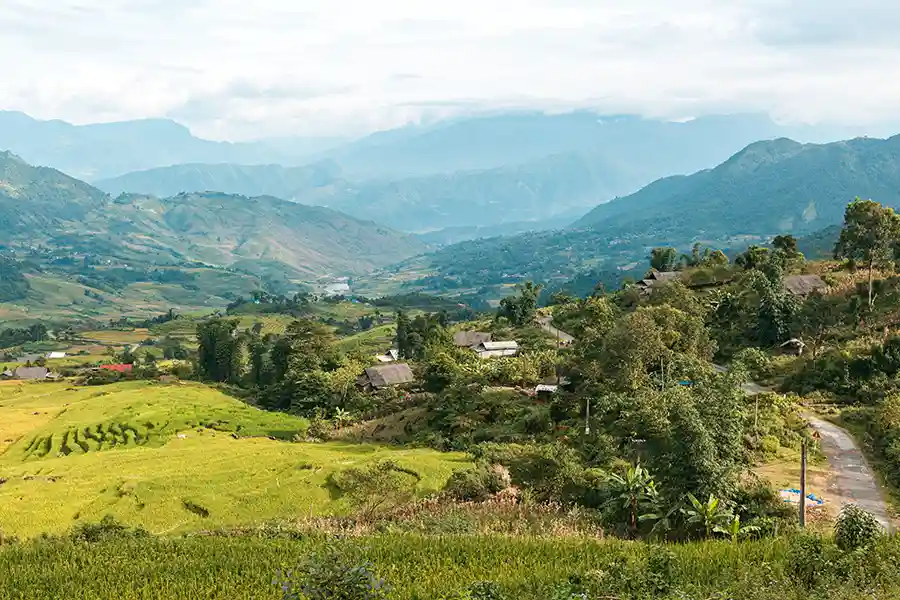
A short drive from Sapa town, the Muong Hoa Valley unfolds its rice terraces down to the river of the same name, linking several H'Mong and Giay villages reachable only on foot. It's our favourite hike for a first immersion into Northern Vietnam: routes, villages along the way, best season and field-tested tips, here's everything you need to know before you go.
What makes hiking in the Muong Hoa Valley so special?
The Muong Hoa Valley holds Sapa's most spectacular rice terraces and several H'Mong and Giay villages reachable only on foot.
About ten kilometres southeast of Sapa town, this valley has been shaped by generations of terraced farming and is the region's most iconic trekking ground. Trails wind between the terraces, follow the Muong Hoa River and pass through hamlets where life still runs on the rhythm of the farming seasons. This is where we take the vast majority of our travellers for their first walking immersion into Northern Vietnam.
What sets Muong Hoa apart from other trekking areas around Sapa is the variety of scenery packed into a relatively short route: stepped terraces, rice fields flooded in spring or golden in autumn, bamboo groves and small suspension bridges over the river.
Which route should you choose to explore the valley?
The classic loop connects Sapa to Ta Van via Lao Chai, roughly 12 to 13 km of walking over half a day to a full day.
The most popular route descends from Sapa town to Y Linh Ho village, then reaches Lao Chai, a Black H'Mong village nestled among the terraces, before continuing to Ta Van, home mostly to the Giay ethnic group. Allow around 4 to 5 hours for the shorter version, or a full day if you extend the walk to Giang Ta Chai.
Elevation gain stays moderate (under 700 metres cumulative on the main loop), which makes this hike accessible to most travellers in reasonable shape, including families with children used to walking.
| Route | Distance | Duration | Level |
|---|---|---|---|
| Sapa → Lao Chai → Ta Van | ~12 km | 4h30 - 5h | Moderate |
| Sapa → Lao Chai → Ta Van → Giang Ta Chai | ~18 km | Full day | Moderate to demanding |
Which villages does the hike pass through?
The route links Y Linh Ho, Lao Chai and Ta Van, three H'Mong and Giay villages where rice terraces surround the houses directly.
Y Linh Ho usually marks the starting point on foot, with the first views over the terraces below. The trail then descends toward Lao Chai, a Black H'Mong village recognisable by its dark wooden houses and indigo-dyeing workshops visible from the path. The hike continues to Ta Van, where the Giay community farms rice on plots that step down toward the river.
These villages are not staged for visitors: you'll come across families working in the fields, children walking home from school and vendors selling handwoven textiles and jewellery along the way. Respecting the local pace is part of the experience we build into our 3-day Authentic Sapa tour, which dedicates a full day to this valley.
When is the best time to hike the valley?
March to May and September to November offer the best conditions, with lush green or golden terraces and dry trails.
From March to May, the terraces fill with water and then turn a tender green with young rice shoots, a highly photogenic period when trails remain in good condition before the summer rains arrive. From September to November comes the golden season: the rice ripens and the terraces take on a spectacular amber hue, usually peaking between mid-September and mid-October.
We generally advise against June to August, when the monsoon makes trails slippery and the terraces are often visually less striking, although the hike remains technically possible for well-equipped travellers.
Do you need a local guide for this hike?
A local guide helps with navigation, adds depth through first-hand knowledge of the area, and directly supports the villages you pass through.
While the first stretch out of Sapa is fairly well marked, the network of secondary trails within the valley can quickly confuse an unaccompanied hiker, especially after heavy rain when some sections turn muddy or slippery. Beyond the practical side, our local guides, often from the villages along the route, make it possible to talk with the families you meet and to understand terrace farming techniques passed down over generations.
It's also a concrete way of channelling tourism income directly to local communities, a principle we've cared about since founding our agency in 2005.
Ready to experience this in Sapa?
Parfum d'Automne, our expert local agency, designs off-the-beaten-path itineraries for you. We weave the gems from our blog into your tailor-made journey.